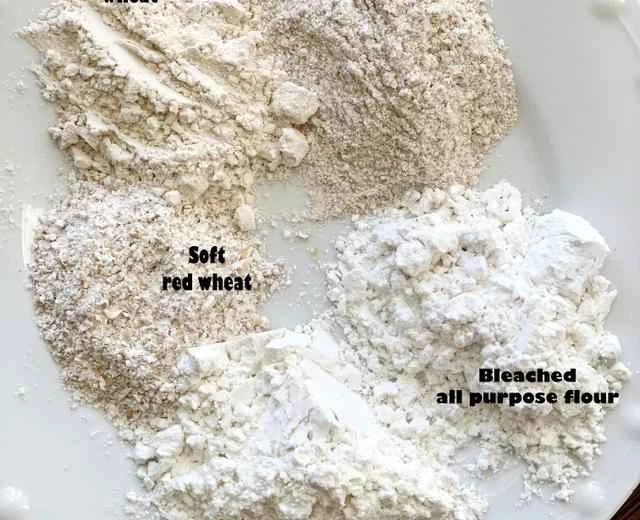
📌 Can you make all-purpose flour with high-gluten and low-gluten flour? Understand the principles of gluten and the perfect substitution ratio! Don't panic if you don't have all-purpose flour on hand. Understanding the principles of "gluten" allows you to flexibly mix high-gluten and low-gluten flour to achieve almost the same results. This article will guide you through the scientific and practical aspects of proper flour mixing, helping you avoid common mistakes! 1️⃣ What is "gluten"? Why mix? "Gluten" refers to the strength of the gluten produced when flour is mixed with water. It comes from the combination of two proteins: ▪️Glutenin provides chewiness and support ▪️Gliadin provides extensibility and elasticity. With the help of water and mixing, these two proteins intertwine to form a network structure, supporting the expansion of bread, the crispness of cookies, and the bouncy texture of dumpling wrappers. If the protein content is too high (like high-gluten flour), the gluten will be too strong and chewy; if it's too low (like low-gluten flour), it will be soft and weak. ⚠️The protein content of all-purpose flour is approximately 10-11%, falling between high-gluten (approximately 12.5-13.5%) and low-gluten (approximately 7-9%), making it suitable for most home baking and Chinese pastry making. 2️⃣How to make all-purpose flour by mixing high-gluten and low-gluten flour? Depending on the recipe, I often use a mixed flour method to achieve the desired consistency. If you want to mix your own all-purpose flour, you're essentially playing a "weighted average math game" 😁 【The most common alternative ratios are】 ▪️70% bread flour + 30% cake flour (7:3) ▪️or 60% bread flour + 40% cake flour (6:4, with a softer gluten) ------------------------------------------- For example, to make 100g of all-purpose flour, you can mix: ▪️70g bread flour + 30g cake flour (average protein content approximately 11%) ▪️or 60g bread flour + 40g cake flour (average protein content approximately 10.2%) This protein concentration is very close to the range of all-purpose flour and can handle most recipes that require all-purpose flour. If your high-gluten and low-gluten flours have different protein contents, you can easily calculate them using this formula: ▪️▪️▪️Target protein × Total weight = High-gluten protein × High-gluten weight (grams) + Low-gluten protein × Low-gluten weight (grams) ⬇️Taking a target of 100g of all-purpose flour and setting the protein content at 10.5% as an example: You have: 12.5% high-gluten and 8% low-gluten Let the high-gluten content be X (g) and the low-gluten content be (100 – X) Using the protein weighted average formula: X × 12.5% + (100 – X) × 8% = 10.5% Divide both sides by %, for easier calculation and understanding → 12.5X + 800 – 8X = 1050 → 4.5X = 250 → X ≈ 55.5g high-gluten, 44.5g low-gluten----------------------------------------------- Therefore, you can use: 👉 Approximately 55g high-gluten + 45g Low-gluten flour, formulated to produce a protein content of approximately 10.5% with medium-gluten flour. 3️⃣ How to proportion flour for different baking products? ▪️ If you are making Chinese pastries such as dumpling wrappers, pan-fried buns, or scallion pancakes, it is recommended to use a 7:3 ratio, which provides a slightly chewy texture without being too hard. ▪️ For scones, sweet cookies, and cakes, a 6:4 or even 5:5 ratio is ideal, as the weaker gluten will result in a more crumbly and softer product. ▪️ For toast and European-style bread, it is recommended to use high-gluten flour directly without mixing it with other flours, as stronger gluten provides better structure. ▪️ For soft breads such as brioche and milk rolls, you can use an 8:2 ratio to slightly reduce gluten content and create a denser texture. ▪️ For doughs that require stretching, such as hand-pulled noodles or knife-cut noodles, a 7:3 or 8:2 ratio is recommended to increase elasticity and cooking resistance. 4️⃣ What differences will occur after mixing? Using high-gluten and low-gluten flour instead of all-purpose flour is feasible, but some subtle changes will still occur: ▪️Different water absorption: High-gluten flour absorbs more water, while low-gluten flour absorbs less. After mixing, the amount of water needs to be adjusted appropriately to avoid the dough being too dry or too wet. ▪️Dough extensibility may differ slightly: If the proportion of high-gluten flour is too high, the dough will be too elastic and difficult to roll out. In this case, let the dough rest for a longer time. ▪️The texture of the finished product may be too chewy or loose: Too much high-gluten flour will result in a too-chewy texture after baking; too much low-gluten flour will cause the finished product to collapse or be too loose. ⚠️The ideal approach is to start with a conservative ratio of "6:4" and gradually adjust it according to the results to find the sweetness point that suits your recipe. ❌Common Mistakes: ▪️Adding only high-gluten flour and not low-gluten flour results in a hard, chewy "fake all-purpose" flour. ▪️Mixing too much flour at once without testing the proportions leads to a ruined texture for the entire batch of cookies or dough. ▪️Using flour directly without sifting results in uneven gluten development and difficulty in mixing. All-purpose flour has just the right amount of gluten, between high and low, making it ideal for everyday baking and Chinese pastries. If you run out or can't find it, as long as you know how to adjust the proportions and understand protein principles, you can flexibly substitute with high-gluten and low-gluten flour to make consistently good-tasting products. ▪️High-gluten + low-gluten = Mixing the all-purpose flour you need. Remember to start with a 7:3 or 6:4 ratio, observe the results, record adjustments, and you'll get better at mixing it! 😊
Materials
High-gluten flour
7|6
Cake flour
3|4
FL flour mixing and preparation steps based on "baking principles"
Step 1
👉Weigh the dough before mixing; do not use measuring cups as different flours have different densities, so weighing is essential for accuracy. 👉Sift the dough at least 1-2 times after mixing to ensure even protein distribution and stable gluten development. 👉Use the premixed flour within a short period; premixed flour is prone to absorbing moisture and spoiling, so it is recommended to use it within 2-4 weeks. 👉Observe the dough's condition during operation and adjust the amount of water and resting time accordingly to avoid uneven gluten development or insufficient extensibility.