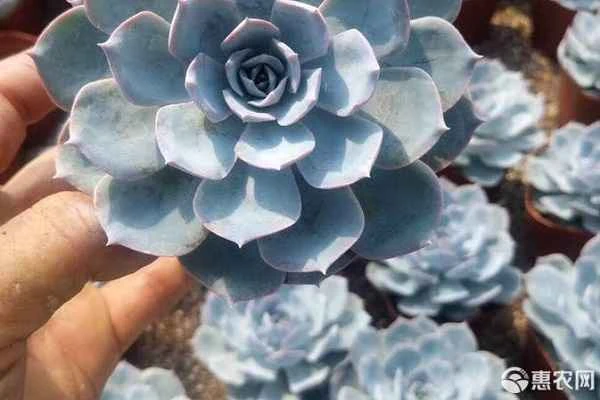
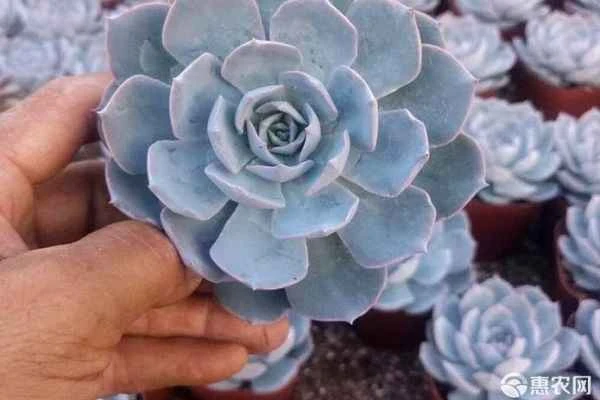
Echeveria 'Blue Stone' is a succulent belonging to the genus Echeveria in the family Crassulaceae . It has very distinctive blue leaves, making it highly ornamental. Moreover, it's affordable and easy to care for, which is why it's loved by many plant enthusiasts. So, how do you properly care for Echeveria 'Blue Stone'? Details are as follows:
1. Potting soil preparation
Blue Stone Lotus succulents are not particularly picky about soil, but it's best to ensure good aeration, high looseness, and sufficient nutrients. For soil mix, you can generally use one part peat moss, one part vermiculite, and one part perlite, with an appropriate amount of bone meal added. Alternatively, you can mix three parts leaf mold, three parts river sand, one part garden soil, and one part cinder.
2. Light temperature
Blue Stone Lotus prefers a sunny, warm, and dry environment. Its leaves will only turn blue under full sunlight. Except for the intense summer sun, when some shade is needed, it's best to let it receive full sun. Maintaining a temperature between 15-28℃ is ideal. Under relatively constant room temperature, Blue Stone Lotus does not have a distinct dormancy period.
3. Watering tips
Blue Stone Lotus doesn't require much water. During its growing season, water thoroughly only when the soil is completely dry, keeping it appropriately dry. During the summer's high temperatures and dormancy period, watering should be reduced. In winter, when temperatures drop below 5°C, watering should also be controlled. When the air is dry, you can also spray water around the plant.
4. Apply fertilizer appropriately
Fertilize once a month during the growing season with diluted cake fertilizer or succulent-specific fertilizer. Avoid getting fertilizer solution on the leaves to prevent burning and affecting the plant's appearance.
5. Prune appropriately
When Blue Stone Lotus is growing, old leaves will grow at the bottom. We need to remove these old leaves in time to promote lignification, branching, and the growth of an old, woody plant.
6. Pest and disease control
Common pests and diseases affecting Blue Stone Lotus include scale insects and black rot. These are usually caused by poor ventilation or overwatering, and are relatively easy to prevent with a little care. You can also keep some insecticides and fungicides such as imidacloprid, abamectin, chlorothalonil, and mancozeb on hand for prevention and control.