January is the coldest month of the year. Fruit trees enter dormancy, with most nutrients stored in large branches, trunks, and underground roots. Pathogens are less likely to invade, pruning results in less sap flow, minimal nutrient loss, vigorous new shoot growth the following spring, fewer side effects, and faster wound healing. Therefore, it is essential to carry out shaping pruning. Seize the opportunity and perform major reshaping as required. Below are the key points of the orchard management plan for January.
1. Shaping and pruning
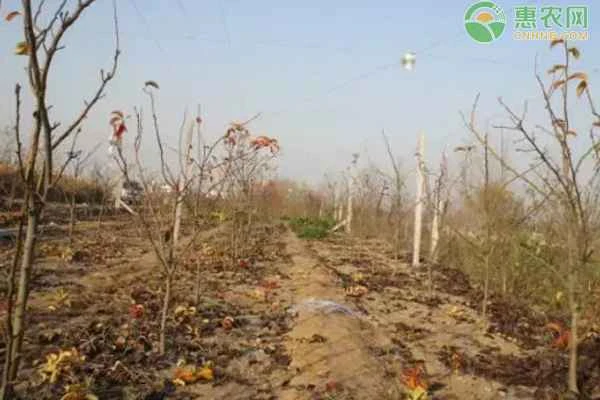
Pruning should be carried out according to the most basic standards of major reshaping among the "Four Major Techniques," emphasizing the "major" aspect. A combination of gentle and thinning pruning methods should be used to cultivate more loose, drooping, curtain-like branch groups on both sides and single-axis extending branch groups, restoring tree vigor as early as possible and improving fruit quality and yield. Major reshaping must be implemented in orchards with irregular tree shapes and high density. After pruning, the tree should have "many branches but not dense, sparse but not empty, strong but not overly vigorous, dense but not sparse, with good ventilation and light penetration." Each branch should occupy its designated position and perform its specific function.
2. Major redesign
(1) Thinning
For orchards with high planting density, the trees should be dug up every two trees or every other tree, depending on the actual situation, so that about 40 trees are left in a standard orchard of 667 square meters and about 70 trees are left in a dwarf orchard.
(2) Promotion
To increase the height of the main trunk, gradually remove the lower branches each year to increase trunk height and introduce "bottom light". It is advisable to remove 1-2 main branches each year, and avoid large-scale pruning that will disrupt the balance of the tree.
(3) Thinning branches
Remove diseased and pest-infested branches, as well as shoots infected with powdery mildew, leaf curl, and small leaf disease. Thin out excessively thick and dense branches on the central trunk. For large lateral branches on the main branches, thin out long ones and keep short ones, and thin out strong ones and keep weak ones, in order to introduce "side light".
(4) Crown reduction
Use smaller branches on the underside of the tree to replace the extension shoots to reduce the crown width, and appropriately prune back excessively long main branches. When the crown extends beyond its designated area, thin out the outer one-year-old branches without shortening them, allowing them to grow slowly at first and then pruning them back. In the orchard, trees can be staggered by about 20 centimeters, and about 1 meter of space should be left between rows to facilitate ventilation and light penetration.
(5) Dropping head
For trees with strong upper growth and weak lower growth, and whose height exceeds the row spacing, the top should be gradually pruned and the canopy opened up over the years. For trees of moderate height, the top can be pruned all at once. A following branch or a 20-30 cm protective stub should be left below the pruning cut. The pruning cut should be at an angle. Pruning and opening up the canopy is like opening a skylight, allowing sunlight to enter. Please remember, "No light, no fruit; no wind, no growth." When pruning back strong perennial branches, pay attention to the cultivation of the posterior branch groups, ensuring the alternating renewal of the leading branch groups and allowing the crown size to expand and contract within a certain range.
(6) Wound protection
Promptly treat and protect pruning cuts. For excessively large wounds, first smooth the cut, then apply a sterile, soft mud, and wrap it tightly with plastic wrap to promote healing. For wounds about 1 cm in size, apply a healing agent for protection. In orchards prone to frost damage, wait until the weather warms up before removing the fruit. When thinning, leave a short stub first.
3. Qingyuan
Thoroughly sweep up fallen branches, leaves, rotten fruit, weeds, mummified fruit, and other debris from the orchard floor, and bury or burn them. This is especially important for reducing the overwintering pest and disease population. The saying "One insect breaks free from its cocoon in winter, ten thousand fewer insects in summer" illustrates this principle. In recent years, to conserve soil moisture, fruit farmers have been spraying high-concentration fungicides , acaricides , and insecticides onto the fruit trees and ground when the leaves turn yellow, covering the orchard floor without clearing the orchard or sweeping up fallen leaves. In spring, when the weather warms up, the leaves are piled up along the tree rows and burned, which both increases the amount of wood ash fertilizer and kills pests and diseases.
4. Snow-covered Garden
If it snows in arid mountainous areas, the snowfall will solve the problem of insufficient water in orchards. The accumulated snow should be promptly transferred to the orchards to irrigate the fields. When covering the trees with snow, it should be 30 centimeters away from the trunk.